
The Daily Battles Inside a Mind at 104
Simple responses that bring comfort during frightening delusional moments.

Welcome to a newsletter themed at the intersection of longevity and wine history. 🍷
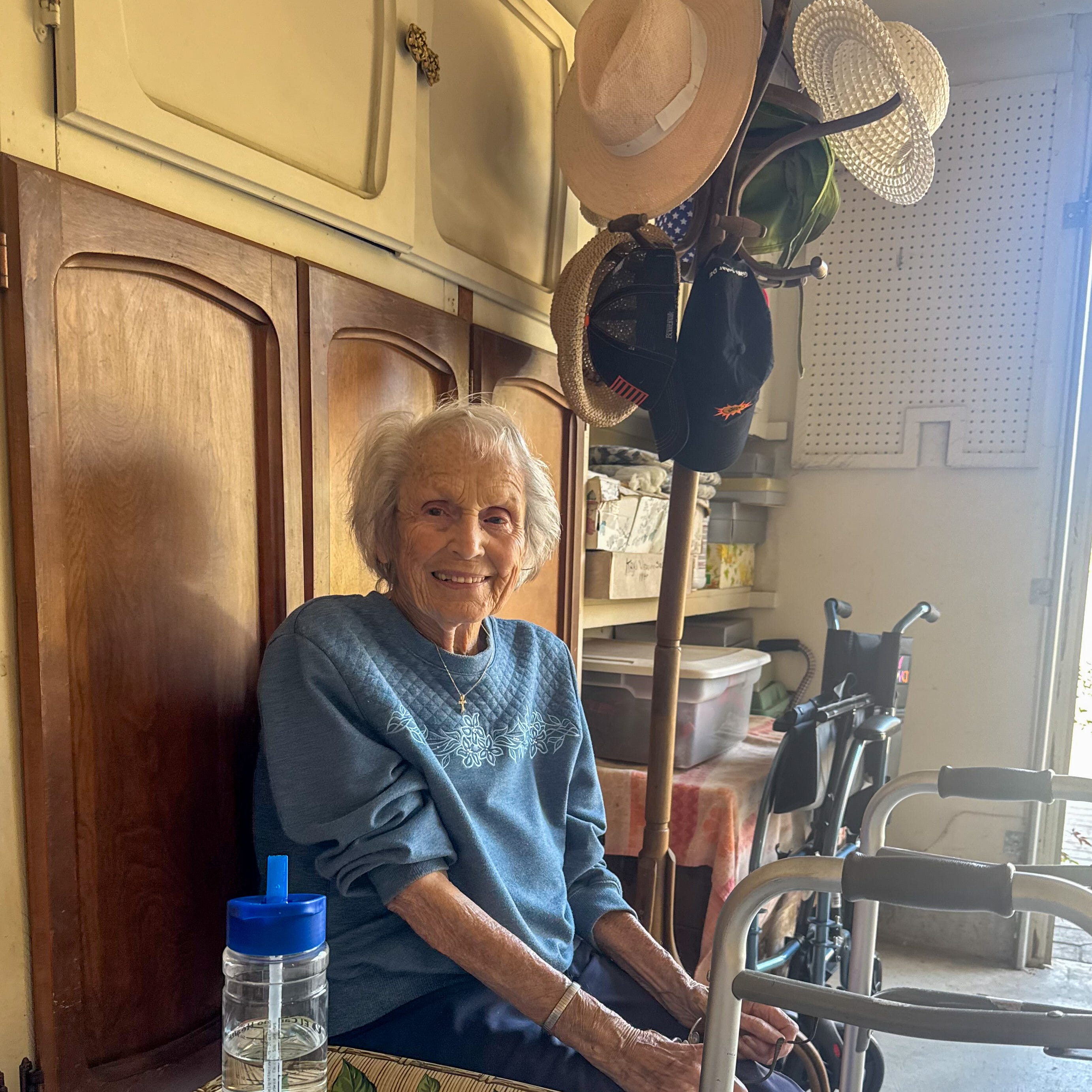
Nov. 10, 2025: Grandma Kay Gemello in her garage
Grandma Kay’s mysteriously missing second car, which I mentioned a few weeks ago, has been on her mind a lot lately. In fact, the empty spot in her garage, where my late grandfather used to park his car 20 years ago, triggered her 104-year-old brain to blurt out: “It’s been stolen.”
She even called one of my uncles demanding that he file a police report.
While she’s never been diagnosed with dementia, doctors throughout her late nineties suggested any memory loss or forgetfulness was common for people her age.
However, she started to have delusions, or firmly held false beliefs about two years ago, likely a result of back to back health issues: a weeklong bout with COVID, followed by a urinary tract infection (UTI). Delusions are common for people in mid- to late-stage dementia, according to the Alzheimer’s Association.
For the past two years, Grandma Kay’s care has been elevated from part-time caregiving to round-the-clock monitoring. She would often question why she needed a caregiver.
Something I’ve learned working with a memory care community years ago is that you’re not supposed to argue with people battling delusions or try to reason with them. Instead, you are supposed to validate their feelings. But it can be hard to turn off our logical brain, especially when she’s telling us to call the police about her delusion of a stolen car.
There’s usually no more than one caregiver visiting her at a time, but perhaps after a shift change, Grandma Kay thinks the previous caregiver is in the kitchen.
“There’s too much traffic in the kitchen,” she’d say sometimes, while sitting in her living room even out of view of the kitchen.
“There’s too much traffic in the kitchen,” she’d say sometimes, while sitting in her living room even out of view of the kitchen.
Recently, one of the caregivers discovered a novel way to ease her anxiety in response to the “traffic.” Sitting next to her in the living room, she clapped her hands and raised her voice: “OK, everybody leave.”
That seemed to calm her nerves for the moment.
Rather than trying to convince her the “traffic” wasn’t real, the Alzheimer’s Association advises family members to acknowledge her distress by saying something like: “It seems like things feel noisy around you. That must be upsetting.”
Experts in cognitive behavior suggest actually going through the motions of flipping a light switch off as opposed to verbally ordering the light switch off can also be helpful. It can give her brain the “done” signal.
The Missing Car Mystery
The day she first claimed her car was stolen, she repeated it multiple times to her caregiver.
Then, while taking a stroll in her backyard near the fence that separates the neighbor’s yard, she encountered her neighbor.
“Hi, Kay. How are you?” he asked. “Have you seen this?”
He was pointing to a busted sprinkler pipe on her side of the property that was flooding the area.
The busted pipe should have been an epiphany. Her water bill had been a source of confusion, tripling in the past month. But instead, Grandma Kay signified that was the least of her problems at the moment.
“Did you steal my car?” she blurted out.
“Did you steal my car?” Grandma Kay blurted out.
Taken aback, he said, “No, but I can help you look for it.”
Later, my mom arrived to take her for a doctor checkup. The doctor’s office is in Mountain View, near El Camino Hospital. To get there, they drove through the hospital’s vast parking lot, which was full of cars.
“Wow! It’s so busy today. Look at all these cars,” she said.
My mom told her the parking lot was for the entire healthcare campus, containing a range of medical office buildings and specialty care surgery offices.
“Maybe we should look for my car here,” Grandma Kay said.
How to Respond to a Perceived Theft
The Alzheimer’s Association says theft-type delusions are among the common delusions in dementia.
Although not grounded in reality, the situation is very real to the person with dementia. A person with dementia is trying to make sense of her world with declining cognitive function.
Here are ways the Alzheimer’s Association suggests responding to dementia patients having delusions.
Don’t take offense. Listen to what is troubling the person, and try to understand that reality. Then be reassuring, and let the person know you care.
Don’t argue or try to convince. Allow the individual to express ideas. Acknowledge his or her opinions.
Offer a simple answer. Share your thoughts with the individual, but keep it simple. Don’t overwhelm the person with lengthy explanations or reasons.
Switch the focus to another activity. Engage the individual in an activity, or ask for help with a chore.
Duplicate any lost items (obviously if they aren’t cars). If the person is often searching for a specific item, have several available. For example, if the individual is always looking for his or her wallet, purchase two of the same kind.
Share your experience with others. Join an online support community, like the Alzheimer’s Association, and share what response strategies have worked for you and get more ideas from other caregivers.
Black Friday Week Promotion
If you value the content in this newsletter, now’s the perfect time to show your support with an upgrade—25% off for new and free-tier subscribers. All content remains free, but upgrades are like donations that help me continue this work.
If you’re new here—hi, I’m Kevin!
I’m the author of 🍷 Rain on the Monte Bello Ridge,🍷 my forthcoming memoir about health, aging and winemaking. (Read the origin story of the book.) 🍇
The Centenarian Playbook is my newsletter, which features:
Healthy aging/longevity tips
Wine history & stories of the Gemello Winery
Ancestry & family research tips
Kevin, I think this is a particularly helpful piece. Reality often seems to fade with the years. Good advice!
Working with older adults sometimes meant working through delusions. It’s really difficult and this is a very helpful guide. Thank you!